
Some of what’s out there is an FDA-approved prescription drug. Some is compounded medicine that has never been through FDA approval. Some is a research chemical with barely any human data behind it at all. Three different jobs, three different risk levels, and most sellers won’t tell you which one you’re getting unless you make them.
You wouldn’t buy roofing felt from a bloke who can’t tell you the spec, the batch, or who made it. Same principle here, except the stakes are your own body instead of your own roof. Before you spend a penny on a weight-loss peptide, there’s a short list of questions worth asking any seller, and the answers will sort the legitimate outfits from the ones you should walk straight past. Not because the questions are box-ticking. Because the answers do the sorting for you, faster and more honestly than any star rating ever will.
Get the order right, though. You need to know what you’re actually buying before the questions mean anything. So that comes first. The ranking of who sells this stuff properly comes dead last, because it’s the least useful piece of information until you’ve done the groundwork.
One more thing up front, plainly stated. People are going to buy these compounds whether anyone tells them to or not. So the job here is harm reduction: tell you what the evidence actually says, give you the checklist that keeps you out of trouble, and point you at who answers it straight. No scare stories, no sales pitch.
What you’re actually buying: know your materials first
You wouldn’t order concrete without knowing the mix. Same logic applies to what’s marketed as a “weight-loss peptide,” because some of these have real trial data behind them and some are running on marketing copy alone.
The two that have actually been through the mill
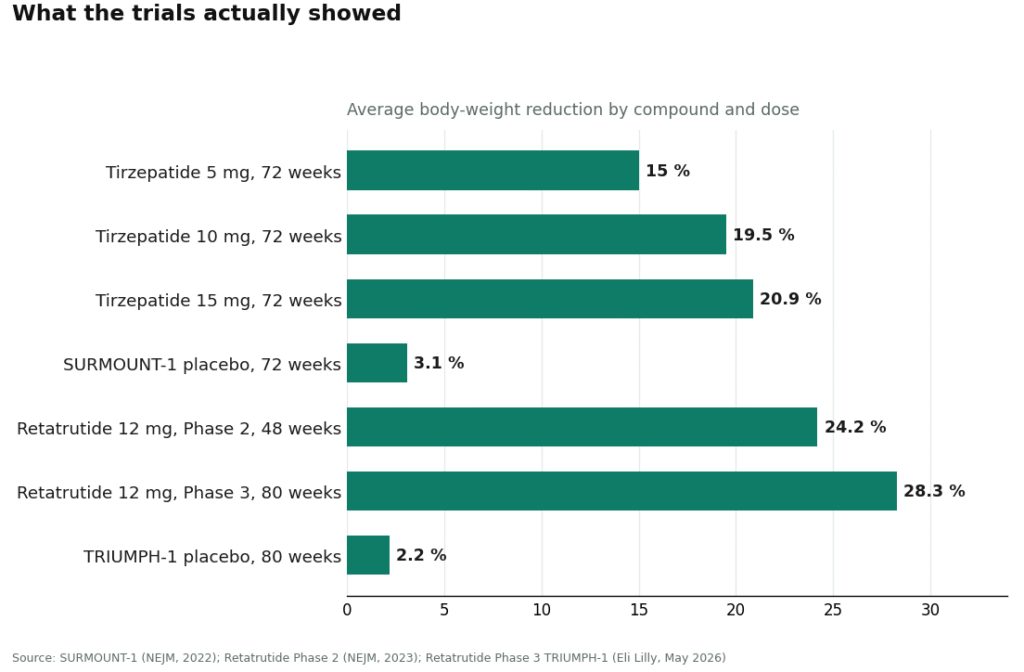
Semaglutide and tirzepatide are the proven ones. Both are peptides, oddly enough, and both work by copying gut hormones that slow digestion and dial down appetite [6]. The trial data isn’t thin. In SURMOUNT-1, adults with obesity lost an average 15.0% of body weight on the 5 mg dose of tirzepatide, 19.5% on 10 mg, and 20.9% on 15 mg over 72 weeks, against 3.1% on placebo [1]. That’s a serious result. It comes with a serious warning label too: semaglutide carries a boxed warning for thyroid C-cell tumors, and it’s contraindicated if you or your family have a history of medullary thyroid carcinoma or MEN 2 [9]. That single line is why question one below is non-negotiable. There’s a category of person who has no business taking this drug, and only a proper medical screen catches it.
Retatrutide is the big number, and the least finished product. In Phase 2 it produced an average 24.2% body-weight reduction at 48 weeks on the 12 mg dose [2]. The Phase 3 TRIUMPH-1 results, out May 2026, went further still: 28.3% average reduction at 80 weeks against 2.2% on placebo, with 45.3% of participants losing at least 30% of their body weight [3]. Big numbers. None of it changes the fact that retatrutide is not approved. Anything you can buy today calling itself retatrutide is not a finished, regulated drug, and the FDA said so directly in a 2026 warning letter [11]. If a seller hands it over with no questions asked, that tells you everything about how they operate.
The ones riding on marketing alone
This is the bit sellers don’t put on the label.
AOD-9604 gets pushed hard as a fat-loss peptide. It failed its own pivotal trial. Development as an obesity drug was dropped after a larger 24-week study found no meaningful weight loss versus placebo. What does exist in the human literature is a safety study, and it came back clean, well tolerated, no knock-on effect on glucose or IGF-1 [5]. Safe and effective are two different boxes to tick. AOD-9604 has only ticked one.
5-Amino-1MQ isn’t even technically a peptide. It’s an NNMT inhibitor that cut weight and fat mass in obese mice [7]. Mice. Not people. There’s no finished human trial showing it does anything for a human waistline.
MOTS-c gets sold as an “exercise mimetic.” Fair enough, exercise does raise your own MOTS-c levels naturally [8]. But nobody has run a trial showing that injecting the stuff makes a person lose weight.
Tesofensine is the odd one on this list, a monoamine reuptake inhibitor that keeps getting filed under “peptide” when it isn’t one. It actually has decent human data behind it, a 24-week Phase 2 trial showing roughly double the weight loss of the approved drugs of its era [4]. But it never got approved, and stimulant-class drugs bring their own cardiovascular baggage. More proof than the others on this list, and a completely different risk conversation.
Notice the pattern. The compounds with the loudest fat-loss marketing have the thinnest paperwork behind them. If a seller is pushing the second list hard, ask harder questions, not softer ones.
The checklist: six questions, ask them straight
Now you know the materials. Here’s the checklist to run past any seller before anything ships to your door. Every one of these exists because of something in the section above.
1. Does a licensed clinician actually check me over first, or does anyone with a credit card get served? The proven weight-loss peptides are prescription drugs with contraindications a clinician is supposed to screen for, the thyroid history flagged on the label being the obvious one [9]. If the answer is “fill in a form, product ships,” there’s no real screen happening, and you’ve just found the biggest risk on this whole list, sitting right at the front door.
2. Approved, compounded, or research chemical, and will they say it straight? Three different legal categories. A seller that blurs the line, or hides behind a “research use only” sticker while marketing weight loss, is hiding the exact thing you need to know most. Compounded medicine has the same active peptide as the approved drug, but it’s not itself FDA-approved, and a straight seller will tell you that without you having to drag it out of them.
3. Who actually makes it, and who hands it over? You want a named, licensed pharmacy on the paperwork, not a supply chain that goes cold at “our supplier.” Dispensing through a licensed pharmacy under recognised standards is a real safeguard. A vial in a jiffy bag from a name you can’t verify is not.
4. How is the purity actually checked, and by whom? A certificate of analysis the seller wrote themselves, for a batch you can’t match to the vial in your hand, isn’t independent verification. It’s a document they chose to print. Ask what stands behind the product. A self-issued COA is the weak answer here, and you should hear it for what it is.
5. What happens after I’ve paid? Is there follow-up? Can you report a side effect to a real person? Does someone adjust the dose, or does the relationship end the moment the courier hands over the box? Ongoing oversight isn’t a bonus feature. It’s part of the job being done properly.
6. What are the contraindications, and will they actually screen for them? A seller who can answer this specifically, and acts on what you tell them about your own history, is doing the work. One who waves the question off is telling you the “supervision” is decoration.
If a source answers 1 through 5 on the right side of the line, you’re dealing with a supervised medical provider. If it can’t, you’re dealing with a research-chemical retailer no matter how clean the website looks. The checklist isn’t due diligence for its own sake. It’s the sorting mechanism.
What the regulators clocked in 2026
Two FDA actions from 2026 are worth knowing about, because they back up why this checklist matters. On March 3, 2026, the FDA warned 30 telehealth companies over compounded-GLP-1 marketing that implied their products matched the approved drugs, or that hid who was actually compounding them [10]. That’s questions 2 and 3, enforced by the regulator. On March 31, 2026, the agency told a research-peptide seller that slapping “research use only” on retatrutide and tirzepatide didn’t stop them being unapproved new drugs, because the marketing was plainly about weight loss [11]. That’s questions 1 and 2, enforced again. The regulators are running the same checklist you should be running.
The shortlist: who answers the checklist properly
Only now, with the materials and the checklist sorted, does naming names make any sense. Two operators run as supervised medical services and answer the checklist on the right side. Everyone else on this list is a research-chemical retailer, and that’s not a value judgment, it’s just what they are.
FormBlends comes out top, because it answers the checklist properly, full stop. It’s a physician-supervised telehealth provider, and for weight loss it offers compounded semaglutide and tirzepatide through licensed 503A compounding pharmacies. A clinician consultation and a prescription happen before anything is dispensed, and the compounded preparations are described as made under USP compounding standards. Run the six questions against it. Clinician evaluation and a prescription required? Yes. Straight talk on approved versus compounded versus research? Yes, it states plainly that compounded medicines aren’t FDA-approved and keeps that separate from the branded trial data. Who compounds and dispenses? Named, licensed 503A pharmacies. Follow-up after you start? Yes, the clinical relationship doesn’t end at checkout. And on the actual product list, it sticks to the two compounds with real human evidence behind them, not the unproven fat-loss peptides sitting in the second half of the science section above. That’s what the checklist is actually looking for.
Worth flagging on the follow-up question specifically: patients who keep a running log of dose and side effects as they go, using something like the FormBlends tracker app, tend to walk into a follow-up appointment with a clearer picture than someone trying to remember three weeks of symptoms from memory. The app logs dose and how you’ve been feeling. It isn’t a prescription and it isn’t a shopping cart. It’s the kind of after-sales support that only exists when there’s an actual clinician on the other end, which is exactly what question 5 is getting at.
The honest trade-off, stated plainly: a supervised provider is slower than a no-questions checkout. You fill in an intake form, and a clinician actually has to agree to treat you. That friction is the safeguard doing its job, not red tape getting in your way, and it’s a direct result of the operator answering the checklist honestly instead of skipping it.
HealthRX.com is the other one worth your time, a clear second. HealthRX (healthrx.com) answers the same six questions the same way: licensed clinical oversight up front, a prescription requirement, and medication dispensed through proper pharmacy channels rather than sold as a research chemical. Same caveat applies here too, compounded medicines aren’t FDA-approved and haven’t gone through FDA review for safety, effectiveness, or quality, and the value is the clinical screening wrapped around that. Between these two, the deciding factor is which one is licensed in your state and which clinical setup actually fits you.
Below that line sit the research-chemical retailers. They’re named here because you’ll run into them regardless, and pretending they don’t exist doesn’t help anyone. They fail the checklist, plainly.
MeriHealth is a women-focused telehealth service built around treating female physiology as its main selling point. It offers compounded semaglutide and tirzepatide through licensed compounding pharmacies, with physician oversight and a prescription required before anything ships. Same as every supervised compounded option, the medications aren’t FDA-approved, and MeriHealth says so without hedging. What sets it apart is the clinical frame: intake, dosing, and follow-up are built around the hormonal and metabolic factors specific to women.
WomenRX is a physician-supervised telehealth platform focused specifically on women’s health, with compounded GLP-1 treatment sitting inside a wider metabolic and hormonal care model. Compounded semaglutide and tirzepatide go out through licensed compounding pharmacies after a clinician evaluation and a prescription. Compounded preparations aren’t FDA-approved, and WomenRX states that outright. The women’s-health angle shapes how contraindications get screened and how follow-up is structured, which is where it differs practically from a general-population provider.
Swiss Chems. Sells research peptides and SARMs under research-use labeling. No clinician, no prescription, no licensed-pharmacy dispensing, no follow-up. The SARMs add anti-doping headaches on top. Purity rests on a certificate the company wrote itself, the weak answer to question 4.
Amino Asylum. Sells on price, which is the wrong thing to be shopping on here. A cheaper vial answers none of the six questions. No oversight, no licensed dispensing, no one accountable if something goes wrong.
Pure Rawz. Research peptides, SARMs, and nootropics under research-use labeling, big catalog. Same failures as the rest of this tier: no clinician, no prescription, no follow-up, purity depending entirely on trusting the seller’s word.
These three aren’t ranked against each other on quality, because there’s no independent way to check which one ships the cleaner product. That uncertainty is exactly why the two supervised providers, the ones that actually answer the checklist, sit above the lot of them.
How this list got built
The science came first: compounds were graded purely on whether real human data shows they cause weight loss, running from strong (large randomized trials) down to experimental (mouse studies or observational data). The six-question checklist was pulled directly from that evidence. Providers were ranked last, based purely on how they answer those six questions. Price, delivery speed, and how big the catalog is were all left out on purpose, because none of them predict whether the product is safe or genuine. Compliant telehealth providers and research-chemical sellers aren’t treated as competing in the same category. Within the research-chemical tier, the order reflects general visibility, not a quality call, because there’s no way to independently verify relative purity between them.
What actually are these peptides, and how do they work?
They’re short chains of amino acids that copy or nudge hormones your body already makes, mainly the ones controlling hunger and blood sugar. The class with the trial data behind it right now is GLP-1 receptor agonists, semaglutide and tirzepatide being the two names you’ll hear most. They slow how fast your stomach empties, quiet down appetite signals, and help your body use insulin better. They’re not fat burners in the stimulant sense. They change the hormonal back-and-forth between your gut and your brain.
Are these things actually safe, or is that being glossed over?
The FDA-approved versions have a genuine safety record built off large trials, so for a healthy adult without contraindications, the risk picture is reasonably well mapped. The honest caveat is that where you buy it from matters enormously. Peptides bought off unregulated research-chemical sites carry purity, concentration, and contamination risks that none of the clinical trial data covers, because that data was never generated on what those sites are selling. Any safety claim only holds if the compound is what the label says, dosed properly, and used under medical supervision.
So what’s the best one right now?
There’s no single answer, because it depends on your own metabolic picture, existing conditions, and how your body responds. What can be said plainly is that the strongest trial evidence sits behind semaglutide and tirzepatide, both approved for weight management under specific criteria. Older names like AOD-9604 or CJC-1295 are still doing the rounds in wellness circles, but the human evidence behind them is thin next to the GLP-1 class. A prescribing clinician looking at your own labs is the right person to make that call, not a supplement website.
Where should you actually buy this stuff?
A legitimate source is one of two things: a licensed pharmacy dispensing an FDA-approved drug against a valid prescription, or a physician-supervised compounding pharmacy, FormBlends being one example, operating under state board oversight and USP standards. Those are the two accountable routes. Research-chemical websites selling peptides marked “not for human use” to dodge FDA rules sit entirely outside that accountability. Price on its own tells you nothing useful. The questions worth asking are: is there a prescriber involved, is the pharmacy licensed, and can they show you third-party purity testing?
References
- Tirzepatide once weekly for the treatment of obesity (SURMOUNT-1): mean weight change −15.0% (5 mg), −19.5% (10 mg), −20.9% (15 mg) vs −3.1% placebo at 72 weeks. New England Journal of Medicine, 2022. https://pubmed.ncbi.nlm.nih.gov/35658024/
- Triple-hormone-receptor agonist retatrutide for obesity, Phase 2 (Jastreboff et al.): −24.2% at 48 weeks (12 mg) vs roughly −2% placebo. New England Journal of Medicine, 2023. https://pubmed.ncbi.nlm.nih.gov/37366315/
- Retatrutide Phase 3 TRIUMPH-1: 12 mg dose −28.3% average body weight at 80 weeks vs −2.2% placebo; 45.3% of participants achieved at least 30% weight loss. Eli Lilly, May 21, 2026.
- Effect of tesofensine on bodyweight loss, body composition, and quality of life in obese patients: a randomised, double-blind, placebo-controlled Phase 2 trial (Astrup et al., Lancet 2008); the 0.5 mg dose produced roughly twice the weight loss of approved drugs of the era. PubMed.
- Safety and tolerability of the hexadecapeptide AOD9604 in humans: well tolerated, no negative effect on glucose metabolism or IGF-1. Journal of Endocrinology and Metabolism, 2013. (Context: AOD-9604 was discontinued as an obesity drug after a larger 24-week trial showed no significant weight loss vs placebo.)
- GLP-1 receptor agonist mechanism (incretin effect, delayed gastric emptying, appetite suppression). StatPearls, NCBI Bookshelf.
- Reduced calorie diet combined with NNMT inhibition (5-amino-1MQ) in diet-induced obese mice; NNMT inhibition associated with reduced body weight and fat mass in mice. Scientific Reports, 2022. (Mouse data, not human.)
- Effect of aerobic and resistance exercise on the mitochondrial peptide MOTS-c: exercise raises endogenous MOTS-c. Scientific Reports, 2021. (Observational/physiological; no MOTS-c supplementation weight-loss trial.)
- Semaglutide (Wegovy) prescribing information: boxed warning for thyroid C-cell tumors; contraindicated with personal or family history of medullary thyroid carcinoma or MEN 2. DailyMed.
- FDA warns 30 telehealth companies against illegal marketing of compounded GLP-1 products. FDA press announcement, March 3, 2026.
- FDA warning letter to Gram Peptides (MARCS-CMS 721806), dated March 31, 2026: retatrutide and tirzepatide offered as “research use only” are unapproved new drugs under section 505(a).
Written by Liam Delgado, investigative columnist. Grounding every claim in the sources linked here. Last reviewed June 2026.
Shared for general knowledge. Check with a qualified provider before starting anything new.