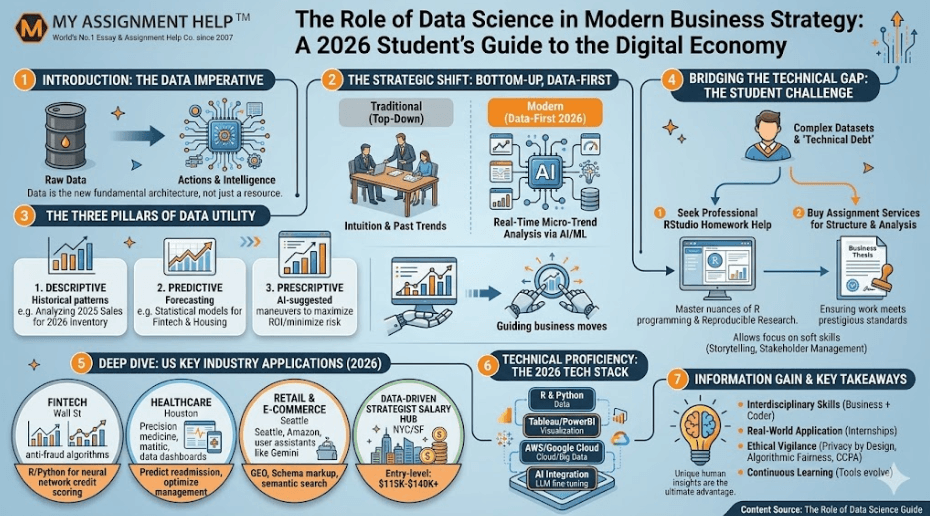
In the hyper-connected US economy of 2026, the mantra “data is the new oil” has evolved. Data is no longer a raw resource to be extracted; it is the fundamental architecture upon which modern business strategy is built. From the high-frequency trading floors of Wall Street to the logistics hubs in the Midwest, the ability to translate “big data” into “actionable intelligence” is the most sought-after skill in the American workforce.
For students currently enrolled in MBA programs or STEM degrees, the intersection of data science and business strategy is where the most lucrative career paths reside. However, the transition from academic theory to corporate application requires a nuanced understanding of how algorithms drive revenue and how technical proficiency dictates strategic agility.
The Evolution of the Strategic Framework
Traditionally, business strategy was a top-down approach dictated by executive intuition and historical precedents. In 2026, we utilize a “Bottom-Up, Data-First” methodology. This involves leveraging machine learning (ML) and artificial intelligence (AI) to analyze micro-trends in real-time, allowing firms to pivot before a market shift fully materializes.
The Three Pillars of Data Utility in the USA
- Descriptive Analytics: Utilizing historical data to identify patterns. For a US retailer, this means analyzing 2025 holiday sales to predict inventory needs for 2026.
- Predictive Analytics: Using statistical modeling to forecast future outcomes. This is critical for the US housing market and fintech sectors.
- Prescriptive Analytics: The “Final Frontier”—where AI suggests specific business maneuvers to maximize ROI or minimize risk.
Bridging the Technical Gap: The Student Challenge
The rigor of US higher education has increased as universities attempt to keep pace with the Silicon Valley tech stack. Students are no longer just writing essays; they are building models. This shift has created a significant “technical debt” for many learners.
When faced with complex datasets involving multivariate calculus or Bayesian statistics, many students find that seeking professional Rstudio homework help is a strategic necessity to master the nuances of the R programming environment. RStudio has become the primary laboratory for data scientists in the States, offering a robust ecosystem for data cleaning, visualization, and reproducible research that is essential for any modern business thesis.
Furthermore, as the academic year progresses and the volume of deliverables increases, students often look to buy assignment services that provide high-level analytical frameworks and structural integrity, ensuring their work meets the prestigious standards upheld by MyAssignmentHelp and other leading academic consultancies in the United States. This allows students to focus on “soft skills”—such as stakeholder management and storytelling—which are just as vital as the hard data itself.
Deep Dive: Data Science Applications in Key US Industries
1. The Fintech Revolution (New York & Charlotte)
In the American financial sector, data science is the backbone of risk assessment. Quantitative analysts (“Quants”) use R and Python to develop algorithms that can detect fraudulent transactions in milliseconds. For a student, understanding “Credit Scoring Models” is no longer about simple math; it is about training neural networks on massive datasets.
2. Healthcare Analytics (Boston & Houston)
The US healthcare system is utilizing data science to move toward “Precision Medicine.” By analyzing patient data across demographics, hospitals can predict “readmission risks” and optimize bed management. Students in Healthcare Administration must now be as comfortable with a spreadsheet as they are with a stethoscope.
3. Retail & E-commerce (Seattle & Los Angeles)
Hyper-personalization is the gold standard. Utilizing Generative Engine Optimization (GEO), companies like Amazon ensure that their products are cited by AI assistants (like Gemini or SearchGPT) when users make inquiries. This requires a deep understanding of Schema markup and semantic search—concepts every marketing student in 2026 must master.
Technical Proficiency: Beyond the Basics
To succeed in the US market, students must look beyond basic Excel. The 2026 “Tech Stack” for a Business Strategist includes:
- Programming: R and Python for data manipulation.
- Visualization: Tableau or PowerBI for presenting data to non-technical stakeholders.
- Cloud Computing: AWS or Google Cloud for handling “Big Data” that exceeds local processing power.
- AI Integration: Understanding how to prompt and fine-tune LLMs for data synthesis.
Data Ethics and Governance in the US
A significant portion of a modern business strategy involves navigating the ethical minefield of data privacy. With the evolution of state-specific laws (like CCPA in California and its successors), US businesses must prioritize “Privacy by Design.” Students must understand that a strategy is only as good as its compliance framework.
Information Gain: The Future of Strategic Thought
As we look toward 2027, the concept of “Information Gain” will dominate. This refers to the value added by a piece of content or a business move that isn’t already present in the market. In a world saturated with AI-generated noise, the human ability to provide unique insights based on data-driven evidence is the ultimate competitive advantage.
Key Takeaways for Students
- Interdisciplinary Skills: Don’t just be a “business person” or a “coder.” Be the person who can speak both languages.
- Real-World Application: Use internships to apply RStudio and Python models to actual business problems.
- Ethical Vigilance: Always consider the “bias” in your data. In the US, algorithmic fairness is a major legal and social priority.
- Continuous Learning: The tools you use today (like RStudio) will evolve; your ability to learn new tools is your most durable asset.
See also: Home Office Design Ideas for Productivity
FAQ Section: Navigating Data Science Academics
Q: Is RStudio still relevant in 2026 with the rise of Auto-AI?
Absolutely. While AI can automate code, RStudio provides the granular control and visualization capabilities required for “High-Stakes” business decisions where “Black Box” AI isn’t trusted.
Q: How do US universities view academic assistance services?
Most institutions encourage tutoring and the use of professional resources to enhance understanding, provided the student remains the primary author of their intellectual growth.
Q: What is the average salary for a Data-Driven Strategist in the USA?
In 2026, entry-level roles in major hubs like San Francisco or NYC start between $115,000 and $140,000, depending on technical proficiency.
Author Bio
Marcus Thorne Senior Academic Consultant & SEO Strategist Marcus Thorne is a veteran in the international academic assistance industry, specializing in technical content strategy for the USA and UK markets. With an expertise in Generative Engine Optimization (GEO) and data analytics, he helps students at MyAssignmentHelp navigate the rigorous demands of modern digital curricula. Marcus is a frequent contributor to tech and business journals, focusing on E-E-A-T principles and information gain in the AI era.
Data Driven Sources & References
- U.S. Department of Labor (2026): Emerging Trends in Computational Business.
- Stanford Institute for Human-Centered AI: Annual Report on Algorithmic Transparency.
- Journal of Business Analytics (Vol 14): The Impact of R-Based Modeling on Corporate ROI.
- Forrester Research: The State of Data Science in US Retail (2025-2026).